Tuesday, May 11, 2010

Friday, May 7, 2010
Problems based on graph
Q1. Draw the graph of 2x+y=6 and 2x-y+2=0. Shade the region bounded by these lines and x-axis. Find the area of the shaded region.
Q2. Solve the following equations graphically: 2x+3y=12; x-y=1
(i) Shade the region between the two lines and x-axis.
(ii) Shade the area bounded by these lines and the y-axis.
(iii) Find the coordinates of the vertices of the triangle formed by the two straight lines and the y-axis.
Q3. Solve the following system of linear equations graphically x-y=1; 2x+y=8 Shade the area bounded by these two lines and the y-axis.
Q4. Solve the following system of linear equations graphically: 2x-3y=1; 3x-4y=1. Does the point (3,2) lies on any of the line?
Q.5 Solve the following system of linear equations graphically: 4x – 5y – 20 =0 ;
3x + 5y –15 = 0 Determine the vertices of the triangle formed by the lines, representing the above equations, and the y-axis.
Q6. Draw the graphs of the equations 2x + y =6 and 2x – y + 2 =0.
a)Determine the vertices of the triangle formed by the lines, representing the above equations, and the x-axis.
b)Shade the region bounded by these lines and x-axis.
c)Find the area of the shaded region.
Q7.Solve graphically the system of linear equations 5x – 6y + 30 = 0,
5x + 4y – 20 = 0. Find the area of the regions bounded by these lines and the x-axis.
Q8.Draw the graphs of the equations: 3x + y – 11 = 0, x – y – 1 = 0 .Find the vertices of triangle formed by the above two lines and x = 0.
Q9. Draw the graphs of the following equations: 4x+3y=24 2x-y-2=0
(i) Find the coordinates of the points where the lines meet the x-axis.
(ii) Find the area of the region bounded by these lines and x-axis.
(iii) Find the area of the region bounded by these lines and y-axis.
Q10. Observe the graph representing pair of linear equations in two variables.
x+y=3 and x-3y=6 given below and answer the following questions:

1)Find the coordinates of the point where line meets x-axis and y-axis.
2)Shade the region bounded by above lines and y-axis
3) Find the vertices of triangle formed by the above two lines and x = 0.
4) Find the area of the region bounded by these lines and y-axis
Q2. Solve the following equations graphically: 2x+3y=12; x-y=1
(i) Shade the region between the two lines and x-axis.
(ii) Shade the area bounded by these lines and the y-axis.
(iii) Find the coordinates of the vertices of the triangle formed by the two straight lines and the y-axis.
Q3. Solve the following system of linear equations graphically x-y=1; 2x+y=8 Shade the area bounded by these two lines and the y-axis.
Q4. Solve the following system of linear equations graphically: 2x-3y=1; 3x-4y=1. Does the point (3,2) lies on any of the line?
Q.5 Solve the following system of linear equations graphically: 4x – 5y – 20 =0 ;
3x + 5y –15 = 0 Determine the vertices of the triangle formed by the lines, representing the above equations, and the y-axis.
Q6. Draw the graphs of the equations 2x + y =6 and 2x – y + 2 =0.
a)Determine the vertices of the triangle formed by the lines, representing the above equations, and the x-axis.
b)Shade the region bounded by these lines and x-axis.
c)Find the area of the shaded region.
Q7.Solve graphically the system of linear equations 5x – 6y + 30 = 0,
5x + 4y – 20 = 0. Find the area of the regions bounded by these lines and the x-axis.
Q8.Draw the graphs of the equations: 3x + y – 11 = 0, x – y – 1 = 0 .Find the vertices of triangle formed by the above two lines and x = 0.
Q9. Draw the graphs of the following equations: 4x+3y=24 2x-y-2=0
(i) Find the coordinates of the points where the lines meet the x-axis.
(ii) Find the area of the region bounded by these lines and x-axis.
(iii) Find the area of the region bounded by these lines and y-axis.
Q10. Observe the graph representing pair of linear equations in two variables.
x+y=3 and x-3y=6 given below and answer the following questions:

1)Find the coordinates of the point where line meets x-axis and y-axis.
2)Shade the region bounded by above lines and y-axis
3) Find the vertices of triangle formed by the above two lines and x = 0.
4) Find the area of the region bounded by these lines and y-axis
Monday, May 3, 2010
Pair of linear Equations in two variables
Assignment
1.Write the condition that the pair of linear equations in two variables ax+by+c=0, lx+my+n=0 are inconsistent.
2. Given the linear equation 3y+2x-9=0, write another linear equation in two variables s.t the geometrical representation of the pair so formed is :
1) intersecting lines
2) parallel lines
3. Does the point(2,-2) lie on the line whose equation is 7x-y-8=0?
4. Write a linear equation in two variables which is consistent to equation 3(x-y)=2.
5. Find the co-ordinates of the point where the line 2x-3y=6 meets x-axis .
6. Find the co-ordinates of the point where the line 5x+10y=10 meets y-axis.
7. How many solutions of the equation 5x-2y+10=0 are possible?
8. Obtain a condition for the following system of equations to have a unique solution ax + by = c lx + my = n
9. The system of equations 3x – 5y = 20 and 6x – 10 y = 40 is _____________(consistent/inconsistent).
10. Find the value of ‘k’ for which the system of equations 3x+2y-4=0 and kx-y-3=0 will represent intersecting lines?
1.Write the condition that the pair of linear equations in two variables ax+by+c=0, lx+my+n=0 are inconsistent.
2. Given the linear equation 3y+2x-9=0, write another linear equation in two variables s.t the geometrical representation of the pair so formed is :
1) intersecting lines
2) parallel lines
3. Does the point(2,-2) lie on the line whose equation is 7x-y-8=0?
4. Write a linear equation in two variables which is consistent to equation 3(x-y)=2.
5. Find the co-ordinates of the point where the line 2x-3y=6 meets x-axis .
6. Find the co-ordinates of the point where the line 5x+10y=10 meets y-axis.
7. How many solutions of the equation 5x-2y+10=0 are possible?
8. Obtain a condition for the following system of equations to have a unique solution ax + by = c lx + my = n
9. The system of equations 3x – 5y = 20 and 6x – 10 y = 40 is _____________(consistent/inconsistent).
10. Find the value of ‘k’ for which the system of equations 3x+2y-4=0 and kx-y-3=0 will represent intersecting lines?
Thursday, April 22, 2010


Wednesday, April 21, 2010
Assignment Based on Activities for Class10
Activitity-2
http://mykhmsmathclass.blogspot.com/search/label/Activity-Linear%20equations%20in%20two%20variables%20(I)
Activity-3
http://mykhmsmathclass.blogspot.com/search/label/Activity-Linear%20equations%20in%20two%20variables%20(II)
Activity-4
http://mykhmsmathclass.blogspot.com/search/label/Activity-Linear%20equations%20in%20two%20variables%20(III)
http://mykhmsmathclass.blogspot.com/search/label/Activity-Linear%20equations%20in%20two%20variables%20(I)
Activity-3
http://mykhmsmathclass.blogspot.com/search/label/Activity-Linear%20equations%20in%20two%20variables%20(II)
Activity-4
http://mykhmsmathclass.blogspot.com/search/label/Activity-Linear%20equations%20in%20two%20variables%20(III)
Saturday, April 17, 2010
Friday, April 9, 2010
Assignment-Polynomials
Q1.Find the zeroes of the following quadratic polynomial and verify the relationship between the zeroes and the coefficients:
(1) 4x^2– 4x – 3
(2) 2x^2 – 1
(3) 6x^2 -3-7x
Q2. Find the quadratic polynomial, the sum and product of whose zeroes are
(1) ½ , -2
(2) –3, -7
Q3. Find all the zeros of x^4 + 3x^3 – 20x^2 – 6x + 36, if two of it’s zeroes are and -
and -
Q4. Write the zeroes of the polynomial x^2 – x – 6.
Q5. Write a quadratic polynomial whose zeroes are 5 and -5.
Q6. The graph of y=f(x) is given below .Find the number of zeroes and the zeroes of f(x):

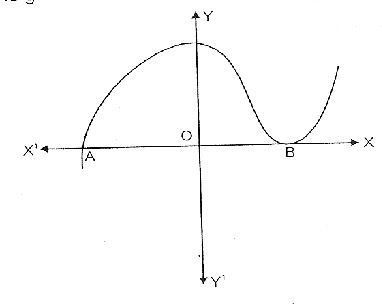
Q7. The graph of y=f(x) is shown below. Find the number of zeros of f(x).

Q8.If the polynomial 6x^4 +8x^3 +17x^2+21x+7 is divided by another polynomial 3x^2+4x+1, the remainder comes out to be ax +b , find a and b.
Q9. Write the general form of quadratic polynomial.
Q10. Write the quadratic polynomial whose zeroes are 2 and 2.
Q11.Give an example of polynomial f(x),g(x),q(x) and r(x) satisfying
f(x)=g(x) q(x)+r(x) where degree r(x)=0.
Q12.If the fourth degree polynomial is divided by a quadratic polynomial, write the degree of the remainder.
Q13. Find all the zeros of x^4 + x^3 – 34x^2 – 4x + 120, if two of it’s zeroes are 2 and - 2.
(1) 4x^2– 4x – 3
(2) 2x^2 – 1
(3) 6x^2 -3-7x
Q2. Find the quadratic polynomial, the sum and product of whose zeroes are
(1) ½ , -2
(2) –3, -7

Q3. Find all the zeros of x^4 + 3x^3 – 20x^2 – 6x + 36, if two of it’s zeroes are
 and -
and -
Q4. Write the zeroes of the polynomial x^2 – x – 6.
Q5. Write a quadratic polynomial whose zeroes are 5 and -5.
Q6. The graph of y=f(x) is given below .Find the number of zeroes and the zeroes of f(x):

Q7. The graph of y=f(x) is shown below. Find the number of zeros of f(x).
Q8.If the polynomial 6x^4 +8x^3 +17x^2+21x+7 is divided by another polynomial 3x^2+4x+1, the remainder comes out to be ax +b , find a and b.
Q9. Write the general form of quadratic polynomial.
Q10. Write the quadratic polynomial whose zeroes are 2
 and 2.
Q11.Give an example of polynomial f(x),g(x),q(x) and r(x) satisfying
f(x)=g(x) q(x)+r(x) where degree r(x)=0.
Q12.If the fourth degree polynomial is divided by a quadratic polynomial, write the degree of the remainder.
Q13. Find all the zeros of x^4 + x^3 – 34x^2 – 4x + 120, if two of it’s zeroes are 2 and - 2.
Subscribe to:
Posts (Atom)